
 Business License

Dehumidifier Capacity Calculation: A Practical Sizing Guide
A facilities manager in Guangzhou installed a 90-liter-per-day dehumidifier in a 500-square-meter warehouse and wondered why the room never dropped below 65% relative humidity. The unit ran continuously. The drain hose flowed steadily. Yet the humidity stayed stubbornly high because the calculation had missed two things: the humid coastal air leaking through the loading bay and the moisture released by stacked wooden pallets.
If you are sizing humidity-control equipment, you already know that the biggest number on the datasheet is not the whole answer. A dehumidifier capacity calculation must account for the space, the moisture entering it, the air exchanged with outdoors, and the conditions under which the unit will actually run. This guide walks through a practical method you can use before requesting model recommendations or quotations.
You will learn how to measure the load, correct for temperature and humidity, apply a safety factor, and compare datasheet ratings on a like-for-like basis. By the end, you will have a documented starting point that a supplier or HVAC engineer can review against approved model data.
Need help matching a unit to your conditions? Explore dehumidification equipment and share your site details for a documented capacity check.
Why capacity ratings alone will mislead you
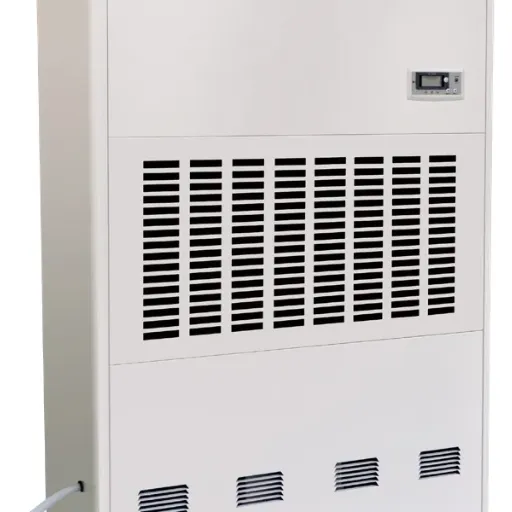
Manufacturers publish dehumidifier capacity in liters per day or pints per day. That figure describes how much water the unit can remove under a specific set of test conditions. Change the temperature or relative humidity, and the same unit produces a different result.
A refrigerant dehumidifier rated at 100 liters per day at 30 °C and 80% relative humidity might deliver less than 30 liters per day at 15 °C and 50% relative humidity. The reason is simple: cold air holds less moisture, and the cooling coil must work harder to reach the dew point. In low-temperature applications, a desiccant unit may be the more appropriate technology.
This is why dehumidifier capacity calculation starts with the room and the load, not the catalog. The right sequence is:
Define the space and the humidity target.
Quantify the moisture sources.
Account for outdoor air infiltration.
Correct for operating temperature and humidity.
Add a safety factor for uncertainty.
Compare model ratings only at matching conditions.
Skipping any of these steps can lead to undersizing, which leaves the humidity problem unsolved, or oversizing, which wastes capital and may cycle the unit too aggressively.
The building blocks of dehumidifier capacity calculation
Every dehumidifier capacity calculation has the same three inputs: the volume of air to be treated, the moisture added inside the space, and the moisture brought in from outside. Think of it as a water balance. The dehumidifier must remove water at least as fast as it enters.
The basic relationship is:
Required capacity = internal moisture load + ventilation moisture load ± safety margin
Internal moisture load comes from people, processes, wet materials, and open water surfaces. Ventilation moisture load comes from outdoor air leaking in or being brought in by mechanical ventilation. The safety margin covers estimation error, seasonal peaks, and future changes in use.
For a quick sanity check, many engineers use a rule of thumb of 0.5 to 1.0 liters per day per cubic meter for lightly loaded spaces in humid climates. However, rules of thumb fail when the load is unusual. A swimming pool room, a construction drying site, or a pharmaceutical cleanroom will need a proper load calculation, not a guess.
Note: Rules of thumb are useful only for early discussion. Always confirm the final capacity with a detailed load calculation and model-specific performance data.
Step 1: Measure the space volume accurately
Start with the physical dimensions. Record length, width, and ceiling height in consistent units. Multiply them to get the total air volume.
Volume = length × width × height
For example, a room measuring 12 meters by 10 meters with a 4-meter ceiling contains 480 cubic meters of air. If the dehumidifier will serve only part of a larger open area, decide where the treated zone ends. Partial treatment only works if there are physical barriers or a deliberate airflow design.
Do not use floor area alone. A warehouse with a 6-meter ceiling holds far more air than a warehouse with a 3-meter ceiling of the same footprint. The volume drives both the moisture storage capacity of the room and the airflow the dehumidifier must move to treat it effectively.
If the space has irregular dimensions, break it into simple shapes and add the volumes. Record the final number and the units you used. Mixed units are one of the most common causes of calculation errors.
Step 2: Identify every internal moisture source
Moisture enters a space in ways that are easy to overlook. List each source and estimate its contribution. The major categories are:
Infiltration through the building envelope: Outdoor air leaks through doors, windows, vents, and construction gaps.
Occupants: An adult at rest releases roughly 50 grams of moisture per hour. Physical activity increases this significantly.
Open water surfaces: Swimming pools, tanks, sumps, and wet floors evaporate large volumes of water.
Process moisture: Cleaning, washing, cooking, cooling, and production steps add water vapor.
Wet materials: Fresh concrete, plaster, paint, lumber, paper, and textiles release moisture as they dry.
Weather and seasonal events: Heavy rain, flooding, or rapid temperature swings can add sudden loads.
For a warehouse storing dry goods, infiltration is usually the largest source. For a pool room, evaporation from the water surface dominates. For a construction site, wet materials may be the entire reason for the dehumidifier.
When Maria sized a dehumidifier for a 2,000-cubic-meter electronics storage room in Shenzhen, she initially counted only the room volume. After a site walk, she added 30 workers during the day shift, frequent door openings to the loading bay, and wooden packaging that had absorbed moisture during shipment. Those additions more than doubled her estimated load. The unit she finally selected was one size larger than her first guess, and it held the room at 45% relative humidity through the rainy season.
Verification required: Process and occupancy loads vary with operating schedules. Confirm the actual operating pattern before finalizing the calculation.
Step 3: Calculate moisture load from ventilation and air changes
Buildings are not airtight. Outdoor air replaces indoor air at a rate called air changes per hour, or ACH. Older industrial buildings may experience 1 to 2 ACH. Tightly constructed modern facilities may fall below 0.5 ACH. A door left open for frequent loading can push the effective rate much higher.
To estimate the ventilation moisture load, you need:
The room volume in cubic meters.
The estimated air changes per hour.
The moisture content of the outdoor design air.
The moisture content of the target indoor air.
The ventilation moisture load in grams per hour is approximately:
Ventilation load = volume × ACH × (outdoor moisture content − indoor moisture content) / 1000
Moisture content is expressed in grams of water per kilogram of dry air. You can find these values from a psychrometric chart or an online calculator using the design temperature and relative humidity for your location and target condition.
For example, suppose you have a 480-cubic-meter room with 1 ACH. Outdoor design conditions are 32 °C and 75% relative humidity, which corresponds to roughly 22 grams of water per kilogram of dry air. Your target indoor condition is 25 °C and 50% relative humidity, which corresponds to roughly 10 grams per kilogram. The ventilation load is:
480 × 1 × (22 − 10) / 1000 = 5.76 kilograms of water per hour, or about 138 liters per day.
That single number often exceeds the capacity of a small commercial unit. This is why dehumidifier capacity calculation must include air changes, not just room volume.
The ASHRAE Fundamentals psychrometric chapter provides the standard methods and data for these calculations.
Step 4: Correct for operating temperature and relative humidity
Dehumidifier performance is not linear. A unit that removes 100 liters per day in hot, humid air may remove a fraction of that in cool, dry air. Manufacturers typically rate capacity at one or more of these conditions:
30 °C, 80% RH: tropical or peak summer conditions.
27 °C, 60% RH: moderate commercial rating.
20 °C, 60% RH: temperate indoor conditions.
10 °C, 50% RH: cold storage or unheated space conditions.
Always state your actual operating range when asking for a recommendation. If the space spends part of the year at 15 °C and 55% RH, a rating at 30 °C and 80% RH will overstate real performance.
For refrigerant dehumidifiers, be especially cautious below 15 °C. The evaporator coil must drop below the dew point of the air to condense moisture. As air temperature falls, the coil must run colder, and frost formation becomes a problem. Automatic defrost cycles reduce effective running time. In these conditions, a desiccant dehumidifier may remove more moisture because it does not rely on condensation.
Tom ran a cold-store loading dock in Melbourne where temperatures stayed between 4 °C and 8 °C. He selected a refrigerant unit based on its 30 °C rating. The unit cycled through defrost constantly and never controlled condensation on the ceiling. After recalculating at his actual operating conditions, he switched to a desiccant industrial dehumidifier sized for low-temperature operation. The dock stayed dry, and the ice buildup on the floor disappeared within a week.
Step 5: Apply a sensible safety factor
Every dehumidifier capacity calculation contains estimates. The air-change rate is a guess. Occupancy varies. Weather spikes. Future operations may add moisture. A safety factor protects against these uncertainties.
Common practice is to add 10% to 25% to the calculated load. Use the lower end when the inputs are well known and the climate is stable. Use the higher end when:
The building envelope is old or leaky.
Operations are likely to expand.
Seasonal humidity peaks are severe.
The load includes wet materials or open water.
The unit must maintain a tight humidity tolerance.
A safety factor is not an excuse to skip the calculation. It is a buffer applied after the calculation is done. An oversized unit that has never been sized correctly is not the same as a correctly sized unit with a reasonable margin.
Worked example: dehumidifier capacity calculation for a warehouse
Let us put the steps together for a small warehouse.
Space: 15 m × 12 m × 5 m = 900 cubic meters
Target condition: 25 °C, 50% RH
Design outdoor condition: 30 °C, 75% RH
Estimated air changes: 1.2 ACH
Occupancy: 8 people during the day
Moisture-sensitive product: packaged electronics in cardboard
First, estimate the ventilation load. At 30 °C and 75% RH, outdoor air holds about 20 grams of water per kilogram of dry air. At 25 °C and 50% RH, indoor air holds about 10 grams per kilogram.
900 × 1.2 × (20 − 10) / 1000 = 10.8 kilograms per hour, or about 259 liters per day.
Next, add internal loads. Eight people contribute roughly 50 grams per hour each, totaling 400 grams per hour, or about 9.6 liters per day. The cardboard packaging may add a small drying load early in storage, so add another 10 liters per day as a conservative allowance.
Total estimated load = 259 + 9.6 + 10 = 278.6 liters per day.
Apply a 15% safety factor: 278.6 × 1.15 = 320 liters per day.
The buyer should now look for an industrial dehumidifier with a documented capacity of at least 320 liters per day at the actual operating condition of 25 °C and 50% RH. If only a 30 °C rating is available, the supplier should provide a capacity curve or correction factor.
Worked example: pool room dehumidifier sizing

A hotel maintenance team needs to dehumidify an indoor pool area.
Space: 20 m × 10 m × 4 m = 800 cubic meters
Pool surface area: 80 square meters
Water temperature: 28 °C
Room air temperature: 30 °C
Target relative humidity: 60%
Evaporation from the pool surface is the dominant load. A common estimating method uses the following relationship:
Evaporation rate = evaporation coefficient × pool surface area × (vapor pressure difference)
For a recreational pool with moderate activity, a simplified estimate is 0.3 to 0.5 liters per square meter per hour. Using 0.4 liters per square meter per hour:
80 × 0.4 = 32 liters per hour, or 768 liters per day.
Add ventilation load. With 1 ACH and an outdoor condition of 32 °C and 75% RH, the ventilation load might add another 150 to 200 liters per day. Occupants add a smaller amount. The total daily load easily reaches 900 to 1,000 liters per day.
A 50-liter-per-day portable unit would be useless in this space. The calculation shows why pool rooms require dedicated pool-dehumidification systems with capacities measured in hundreds or thousands of liters per day.
Have a space with open water or wet materials? Discuss your application requirements so the moisture load can be reviewed against documented model performance.
Common mistakes in dehumidifier capacity calculation
Even experienced buyers make errors when sizing dehumidifiers. Watch for these pitfalls:
Using floor area instead of volume: A high-ceiling space holds more air and needs more capacity.
Ignoring air changes: A leaky building can double the required capacity.
Comparing ratings at different conditions: A 100-liter rating at 30 °C is not equal to a 100-liter rating at 10 °C.
Forgetting internal loads: People, processes, and wet materials add moisture the unit must remove.
Oversizing without calculation: A larger unit is not always better. Poor humidity control can result from short cycling.
Neglecting seasonal variation: A unit sized for average conditions may fail during peak humidity.
Selecting refrigerant units for cold spaces: Below 15 °C, desiccant technology is often the better fit.
Skipping the safety factor: Real buildings behave differently than spreadsheets.
When the procurement team at a textile mill in Istanbul selected a dehumidifier for raw-material storage, they asked the supplier to show the capacity at 15 °C and 50% RH rather than the catalog's 30 °C rating. That request revealed that two apparently similar units had very different real-world performance. They chose the unit with the better low-temperature curve, even though its headline rating was lower. Humidity in the storage area stayed within tolerance through the winter.
How to verify capacity claims on a datasheet
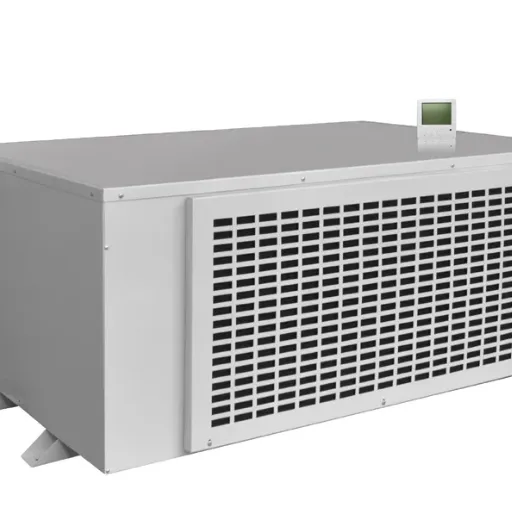
Once you have your calculated load, compare it to manufacturer datasheets carefully. Request the following information:
Rated capacity at your operating temperature and relative humidity, not just the headline condition.
Airflow rate in cubic meters per hour or cubic feet per minute.
Operating temperature and humidity range.
Power input at the rated condition.
Capacity curve or table across a range of temperatures.
If the datasheet only shows one rating point, ask for additional test data. A responsible supplier will provide capacity curves or a selection software output that shows performance at your conditions.
Create a comparison table with one row per candidate model and columns for capacity at your condition, airflow, power, voltage, dimensions, noise, and operating range. Fill in values directly from the datasheets. Do not mix ratings from different test conditions.
Also remember that capacity is only one specification. A unit with the right capacity but insufficient airflow may not distribute dry air evenly through the space. A unit with enough capacity but the wrong voltage or drainage arrangement may be impossible to install.
For a broader view of the selection process, see the related guide on how to choose an industrial dehumidifier.
When to bring in an HVAC engineer
Simple applications with stable conditions can be sized using the method in this guide. Complex applications should involve a qualified engineer. Consider professional support when:
The space has large open water surfaces.
Humidity control is critical to product quality or safety.
The building has mixed uses or varying occupancy.
Mechanical ventilation is part of the design.
You need to integrate the dehumidifier with a building management system.
Local codes or insurance require documented engineering calculations.
An engineer can run a full psychrometric analysis, model air distribution, and specify controls. The cost of engineering support is usually small compared with the cost of installing the wrong equipment.
Dehumidifier capacity calculation checklist
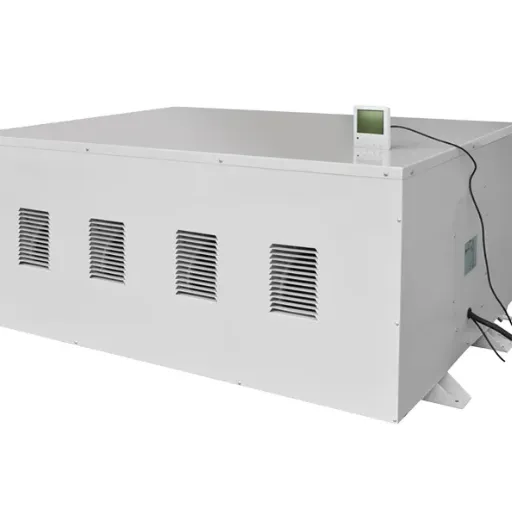
Use this checklist to organize your calculation before contacting a supplier:
Measure the space length, width, and height to get volume.
Define the target temperature and relative humidity.
Identify all internal moisture sources and estimate their contribution.
Estimate the air changes per hour for the space.
Find the outdoor design temperature and humidity for your location.
Calculate the ventilation moisture load using psychrometric data.
Add internal loads to get the total daily moisture load.
Correct the required capacity for your actual operating conditions.
Apply a 10% to 25% safety factor.
Request model datasheets with capacity at your conditions.
Compare like-for-like ratings and verify installation requirements.
For a printable version of this checklist, download the equipment selection checklist.
Conclusion
A dehumidifier capacity calculation is not a single number from a catalog. It is a water balance built from the space you are treating, the moisture entering it, the air exchanged with outdoors, and the conditions under which the unit must operate.
Start with accurate volume measurements. List every moisture source, including people, processes, wet materials, and open water. Estimate air changes honestly and calculate the ventilation load with psychrometric data. Correct the result for your actual temperature and humidity. Add a safety factor that reflects the uncertainty in your inputs. Then compare only those model ratings that share the same test conditions.
The right calculation protects products, reduces downtime, and avoids the cost of an undersized or unsuitable unit. The wrong calculation leads to persistent humidity problems and repeated replacement.
Request a quotation for an industrial dehumidifier matched to your calculated load, operating conditions, and documentation requirements. XiAn Wisdom Computer Info&tech Co., Ltd can review your dehumidifier capacity calculation and confirm which dehumidification equipment category fits your project.
Recently Posted
-
Refrigerated cabinet power and temperature requirements: a buyer's checklist
August 8, 2026In March 2025, a buyer named Elena took delivery of three refrigerated cabinets for a grocery store her company was fitting out. T Read More
 -
Refrigerated Cabinet Selection Checklist: How to Specify the Right Unit for Your Operation
August 8, 2026Maria, a procurement manager for a mid-sized foodservice distributor, thought she had done everything right. She compared three re Read More
 -
What affects dehumidifier capacity? A buyer's guide to accurate sizing
August 8, 2026Last summer, a warehouse manager in Florida ordered a 50 L/day dehumidifier for a 2,000 m² storage area because the supplier's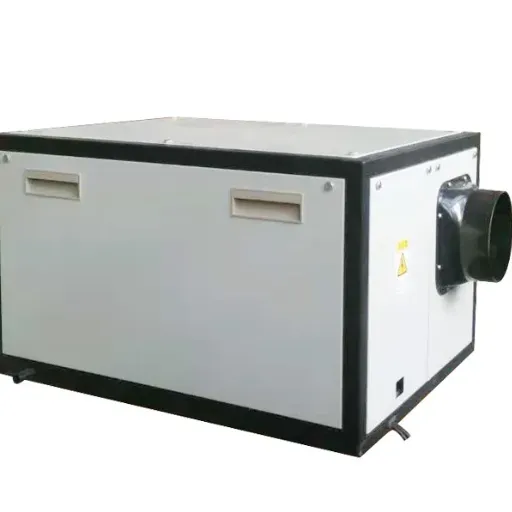 Read More
 -
Dehumidifier installation and drainage requirements: a buyer's guide
August 8, 2026In March 2024, a maintenance team at a seafood processing plant installed a commercial dehumidifier without checking the drain slo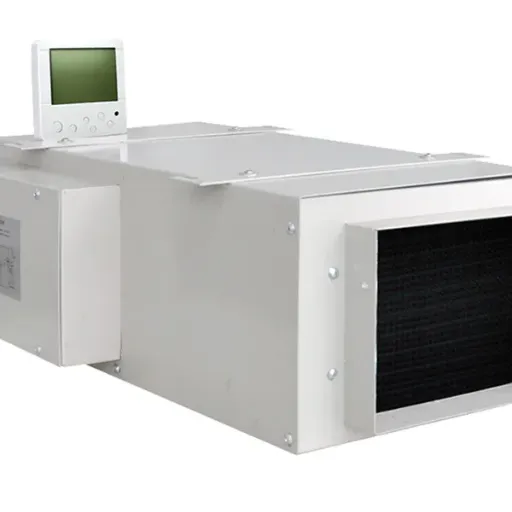 Read More

Contact Us
Recommended Products
-
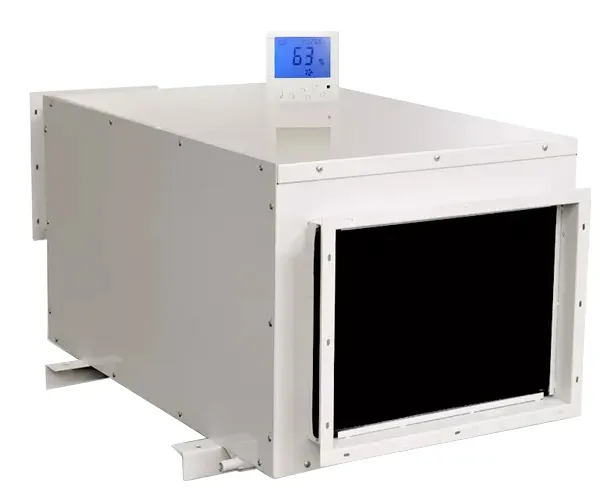
 Large Capacity Ceiling Mounted Space Saving Indoor Pool DehumidifierNegotiableMOQ: 1 Piece
 -
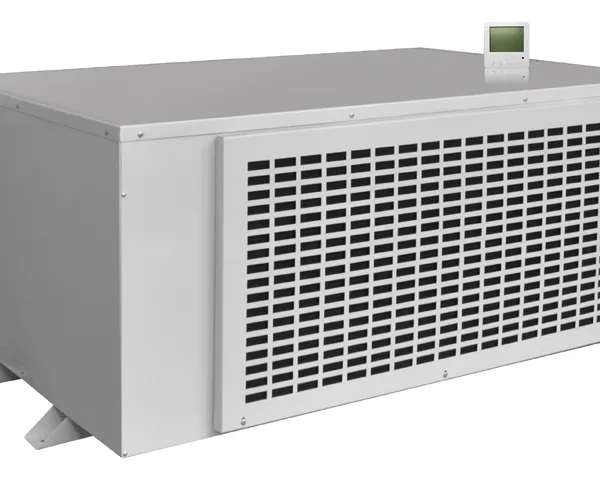
Commercial Home Use Bathroom Dehumidification Swimming Pool Ceiling Mounted Mini DehumidifierNegotiableMOQ: 1 Piece
-
Greenhouse Grow Room Industrial Ceiling Mounted Duct Indoor Pool DehumidifierNegotiableMOQ: 1 Piece
-
Duokai OEM Indoor Dehumidifier Portable Swimming Pool Dehumidifier in Stock With CENegotiableMOQ: 1 Piece
-
High Quality Low Voltage ODM & OEM PLC Distribution CabinetNegotiableMOQ: 1 Set
-
Saladin Type Malt Production LineNegotiableMOQ: 1 Set
-
Seawater Desalination SystemUS$ 2000 - 1000000MOQ: 1 Set
-
High Speed Synthetic Lane Bowling Ball ReturnUS$ 50 - 2000MOQ: 10 Pieces
-
Reliable Automatic Six Axis Industrial Packing Robot With Self Diagnostic SystemNegotiableMOQ: 1 Piece
-
Multi-Travel Radius Six Axis Servo Robot for Custom Automation WorkstationNegotiableMOQ: 1 Piece

-
Labor Saving 6 Axis Industrial Robot Boost Workshop Production EfficiencyNegotiableMOQ: 1 Piece
-
Factory Direct Wholesale Carton Palletizer Packing Line Robot for MilkNegotiableMOQ: 1 Piece
-
Six-Axis Industrial Robotic Arm for Handling Welding Loading UnloadingNegotiableMOQ: 1 Piece
-
High-Automation High-Precision Six-Axis Metal Laser Industrial Welding RobotNegotiableMOQ: 1 Piece
-
Six-Axis Automatic Industrial Welding Robot Arm With Competitive PriceNegotiableMOQ: 1 Piece