
 Business License

How to choose a dry ice machine: a buyer's selection guide
What happens when your dry ice supplier misses a delivery during your busiest production week? For many food processors, cold-chain operators, and industrial cleaning contractors, that single question is what starts the search for a dry ice machine.
If you are reading this, you probably already know that buying dry ice from a third-party supplier means accepting someone else's schedule, minimum order quantities, and sublimation losses in transit. Producing dry ice on your own site can remove those constraints. However, it also introduces new decisions about machine type, carbon dioxide (CO2) supply, installation conditions, and safety.
This guide walks you through the selection process step by step. You will learn how to define your application, compare dry ice machine types, plan for CO2 supply and utilities, address safety requirements, and request the model documentation you need before requesting a quotation. Every recommendation follows one principle: start with your application, then confirm model-specific details from current documentation.
Start with the application, not the machine
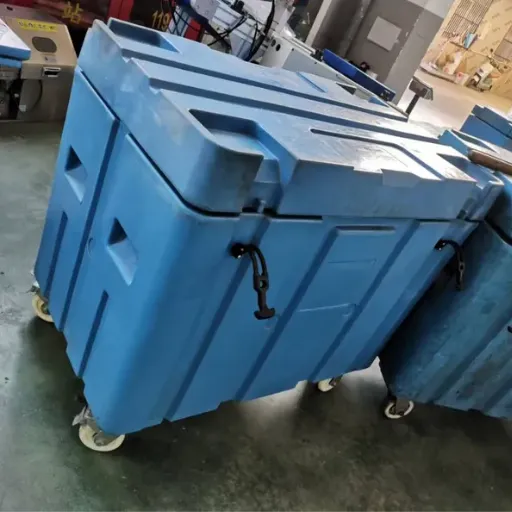
The most common selection mistake is comparing machine prices before defining what the dry ice will be used for. Different applications need different ice formats, output rates, and production schedules. A machine that suits one operation can be a poor fit for another, even at the same price.
Here is an illustrative example. A procurement manager we will call Daniel was sourcing dry ice for a seafood packing line. His team used about 150 kg of dry ice per day to keep export cartons cold during air freight. Instead of checking the required ice format first, he shortlisted machines by output capacity alone.
The first quotation he received was for a pelletizer producing 16 mm pellets, a format suited to cooling and shipping. Fortunately, he also asked the supplier about block production for longer holding times, and the discussion revealed that his actual need was high-density slices that sublimate more slowly. Checking the application first changed the entire shortlist.
Before you contact any supplier, write down the answers to these questions:
What will the dry ice be used for? Common uses include food processing and cooling, cold-chain shipping, dry ice blasting (surface cleaning), and laboratory or medical storage.
What ice format does the application need? Pellets, blocks, and slices behave differently in storage, dosing, and cooling performance.
How much dry ice do you use per day or per shift? Measure current consumption over several weeks if you already buy dry ice externally.
When do you need production? Continuous operation, batch production, and on-demand production place different demands on the machine and the CO2 supply.
Where will the machine operate? Note the ambient temperature, available floor space, ventilation, and electrical supply at the intended location.
Note: Dry ice usage figures in this article are illustrative. Measure your own consumption and confirm all model capacities against current supplier documentation.
Once these answers are documented, the equipment conversation becomes much more productive. If you want to see how a supplier handles this kind of enquiry, you can request model documentation for the equipment category you are considering before you discuss a specific model.
Understand dry ice machine types
A dry ice machine converts liquid CO2 into solid dry ice. In broad terms, liquid CO2 is expanded to form dry ice snow, which is then compressed into the final format. The main categories differ in what they produce.
Dry ice pelletizers
A dry ice pelletizer compresses dry ice snow into cylindrical pellets through a die. Pellet diameter typically ranges from about 3 mm up to 16 mm or more, depending on the die. Small pellets around 3 mm are commonly used for dry ice blasting, while larger pellets are typically used for cooling, catering, and shipping applications.
Pelletizers are the most common choice for buyers who need flexible, portioned dry ice. Output capacity varies widely by model, from tens of kilograms per hour for compact units to several hundred kilograms per hour for industrial machines. Confirm the rated output, and the conditions behind that rating, in the model documentation.
Dry ice block and slice machines
Block machines press dry ice snow into solid blocks or slices. Blocks and slices have a lower surface-area-to-volume ratio than pellets, so they sublimate more slowly. This makes them a common choice for longer holding times, transport cooling, and applications where the ice is cut or weighed into portions. When comparing dry ice machine formats, weigh blocks against pellets for your holding-time and dosing needs.
A common confusion: dry ice blasting machines
A dry ice blasting machine is cleaning equipment that accelerates dry ice pellets through compressed air to clean surfaces. It does not produce dry ice. If your goal is surface cleaning, you need both a blasting machine and a source of pellets, whether purchased or produced by your own pelletizer. Confirm which category a supplier is quoting before comparing prices.
Which type fits which application?
| Application | Typical format | Machine type to discuss |
|---|---|---|
| Dry ice blasting | Small pellets (around 3 mm) | Pelletizer with suitable die |
| Cold-chain shipping | Larger pellets or slices | Pelletizer or block machine |
| Food processing cooling | Pellets or slices | Pelletizer or block machine |
| Long holding times | Blocks or slices | Block or slice machine |
| Catering and events | Pellets | Pelletizer |
This table reflects common industry practice, not a model recommendation. Confirm format options and die sizes for the specific machine under consideration.
Plan capacity and CO2 supply
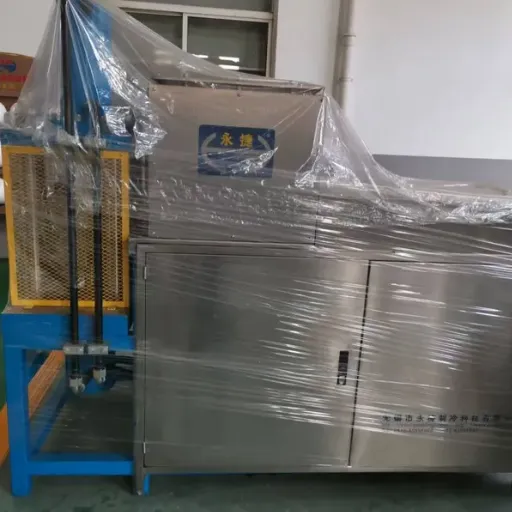
Capacity is more than a kilograms-per-hour figure on a datasheet. Your usable capacity depends on the CO2 supply, the production schedule, and how much produced ice you will lose to sublimation before use.
Match output to real consumption
Estimate your daily or shift-based dry ice consumption, then decide how much of it you want to produce in each run. Dry ice sublimates continuously at about -78.5 °C, so dry ice production timed close to actual use reduces waste. A common planning approach is to size the machine so that a normal production run fits within a fraction of a shift, leaving room for peak demand.
Returning to our illustrative example, Daniel measured three months of purchase records and found that usage varied between 120 kg and 190 kg per day. He planned production around the average plus a margin, and scheduled runs for the morning of each shipping day. That approach avoided both under-capacity and unnecessary storage losses.
Understand the liquid CO2 requirement
Dry ice machines require a supply of liquid CO2, typically stored in a pressurized tank at roughly 20 to 22 bar and low temperature. The CO2 is usually supplied by an industrial gas company under a supply agreement. Before ordering equipment, confirm the following with your gas supplier and the machine supplier:
Tank arrangement: Will you install an on-site liquid CO2 tank, and who supplies and maintains it?
Supply pressure and quality: What pressure range and CO2 purity does the machine require? Confirm this from the model documentation.
CO2 consumption ratio: Producing dry ice releases a significant share of the CO2 as gas during expansion. Ask the machine supplier for the documented CO2-to-dry-ice conversion ratio for the model under consideration, since it directly affects your operating cost.
Delivery logistics: Can a gas tanker access your site, and what are the minimum delivery quantities?
The conversion ratio matters more than many buyers expect. In our illustrative example, Daniel initially budgeted CO2 purchases equal to his dry ice needs. When the supplier explained that a substantial portion of the liquid CO2 returns to gas during production, his cost model changed and so did his payback calculation. Ask for the documented ratio early.
Ready to move from planning to specifics? Prepare your application, daily consumption, and site conditions, then discuss your dry ice production requirements with the supplier so the recommendation can be checked against your situation.
Check site, utility, and safety requirements
A dry ice machine is industrial equipment with real installation demands. Review these requirements before you finalize a model, not after delivery.
Electrical and installation requirements
Confirm the rated voltage, frequency, and power consumption from the model documentation, and check them against your local supply. Also confirm dimensions, weight, required clearances, and any floor-loading considerations. If the machine includes a hydraulic power pack or refrigeration components, ask about ambient temperature limits for the installation room.
Ventilation and CO2 safety
CO2 is heavier than air and can accumulate at floor level in poorly ventilated spaces. High concentrations create an asphyxiation hazard. Workplace exposure limits exist in many jurisdictions; for example, the United States Occupational Safety and Health Administration (OSHA) sets a permissible exposure limit of 5,000 parts per million as an 8-hour time-weighted average for CO2. Review the guidance from OSHA and your local authority, and plan ventilation or CO2 monitoring accordingly.
The dry ice machine safety requirements for your facility should also cover:
Operator protection: Dry ice at about -78.5 °C causes severe cold burns on contact. Plan insulated gloves and handling procedures.
Ventilation design: Mechanical ventilation or low-level extraction may be needed where CO2 is produced, stored, or used.
CO2 monitoring: Fixed or portable CO2 monitors with alarms are a common precaution in production and storage areas.
Pressure systems: The liquid CO2 circuit operates under pressure. Confirm applicable pressure-equipment requirements for your destination market and request the relevant documentation for the machine.
Industry organizations such as the Compressed Gas Association publish guidance on CO2 handling. Request the machine supplier's safety documentation and confirm which standards apply to your market.
Transport and regulatory context
If you ship products with dry ice, note that dry ice is regulated in air transport as a dangerous good (UN 1845). The International Air Transport Association (IATA) publishes packing and labeling requirements on iata.org. This does not change machine selection, but it affects how your produced ice will be packed and documented downstream.
Request dry ice machine documentation before comparing models
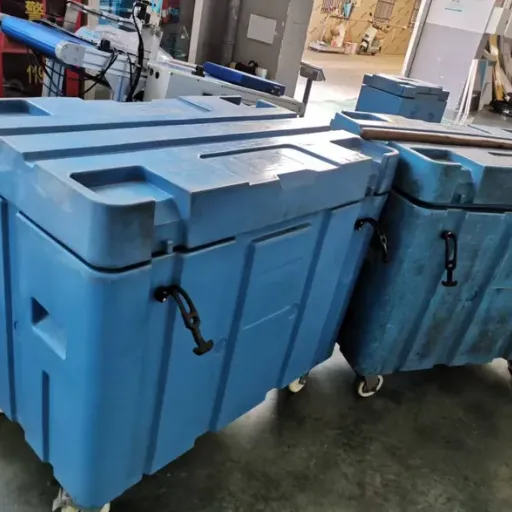
Price comparisons between suppliers are only meaningful when the underlying specifications are documented and comparable. A general product listing rarely tells you what you need to know. For each candidate dry ice machine, request current documentation covering:
Model number and rated output, with the operating conditions behind the rating
Ice formats and die or mold options available for the model
CO2 supply requirements: pressure range, connection, purity, and documented consumption ratio
Electrical requirements: voltage, frequency, phases, and rated power
Dimensions, weight, and installation clearances
Safety documentation: applicable declarations, manuals, and any certification evidence relevant to your destination market
Document version and date, so you know the information is current
Compare models on a like-for-like basis. Two machines with the same nominal output can differ in CO2 efficiency, format flexibility, footprint, and documentation quality. If a specification is not listed, ask for written confirmation rather than assuming compatibility.
You can use an equipment selection checklist to structure this comparison across suppliers, and review the available dry ice machine options once your application requirements are written down.
Confirm commercial and support information
Technical fit is only half of the decision. Before you request a final quotation, confirm the commercial and support terms in writing for the specific model and order:
Quotation scope: Confirm what the price includes, such as dies, spare parts kits, commissioning, and training.
Lead time and delivery terms: Confirm current production lead time and the delivery arrangement for your destination.
Warranty and service: Request written warranty terms and ask which manuals, parts information, and support processes apply to your model and market.
Payment terms and minimum order quantity (MOQ): Confirm in writing before negotiation.
Destination-market suitability: Confirm electrical configuration, documentation language, and applicable compliance requirements for your country.
Suppliers that work with international buyers, including XiAn Wisdom Computer Info&tech Co., Ltd, typically expect this kind of structured enquiry. The company lists dry ice machines among its product categories and states that quality management and after-sales support are central to its service approach. As with any supplier, confirm model availability, specifications, and service terms from current documentation before ordering.
Conclusion: build your checklist, then compare
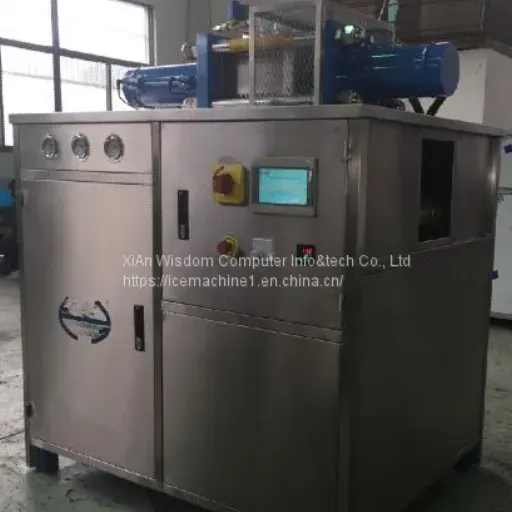
Choosing a dry ice machine becomes straightforward when you follow the right order of decisions. Keep these takeaways in mind:
Define the application first. The required ice format and consumption pattern determine everything else.
Choose the machine category (pelletizer, block or slice machine) based on the format your application needs, and do not confuse production machines with dry ice blasting equipment.
Plan the CO2 supply early. Confirm tank arrangements, supply pressure, and the documented CO2-to-dry-ice conversion ratio, because it drives operating cost.
Treat safety as a design requirement. Ventilation, CO2 monitoring, cold-contact protection, and pressure-system documentation belong in the plan from day one.
Compare documented models, not listings. Request current datasheets, safety documentation, and written commercial terms before deciding.
Your next step is practical: write down your application, daily consumption, site conditions, and destination market. Then share that information with your shortlisted suppliers and request model-specific documentation.
Request dry ice machine documentation or discuss your application →
A well-prepared enquiry gets you a better answer, a faster quotation, and a machine that actually fits your operation. Start with the application, verify the model details, and the rest of the decision follows.
Recently Posted
-
Centrifugal blower selection: how to choose the right model for your application
August 12, 2026Most centrifugal blower selection mistakes are not made inside the machine. They are made before the enquiry goes out, when a buye Read More
 -
How to Select a Pump for Your Application: A Buyer's Guide
August 12, 2026In March 2026, a maintenance supervisor at a beverage plant in Monterrey filed a one-line request: "Get us a new water pump.& Read More
 -
Industrial Pump Selection: A Practical Guide for Buyers
August 12, 2026A plant engineer at a beverage bottling facility in Rotterdam ordered three pumps in March 2025, choosing them by flow rate and pr Read More
 -
How to choose water treatment equipment: a buyer's selection guide
August 12, 2026What would a failed water-quality audit cost your operation? For a food processor, a beverage plant, or a commercial facility, the Read More

Contact Us
Recommended Products
-
 Large Capacity Ceiling Mounted Space Saving Indoor Pool DehumidifierNegotiableMOQ: 1 Piece
 -
Commercial Home Use Bathroom Dehumidification Swimming Pool Ceiling Mounted Mini DehumidifierNegotiableMOQ: 1 Piece
-
Greenhouse Grow Room Industrial Ceiling Mounted Duct Indoor Pool DehumidifierNegotiableMOQ: 1 Piece
-
Duokai OEM Indoor Dehumidifier Portable Swimming Pool Dehumidifier in Stock With CENegotiableMOQ: 1 Piece
-
High Quality Low Voltage ODM & OEM PLC Distribution CabinetNegotiableMOQ: 1 Set

-
Saladin Type Malt Production LineNegotiableMOQ: 1 Set
-
Seawater Desalination SystemUS$ 2000 - 1000000MOQ: 1 Set
-
High Speed Synthetic Lane Bowling Ball ReturnUS$ 50 - 2000MOQ: 10 Pieces
-
Reliable Automatic Six Axis Industrial Packing Robot With Self Diagnostic SystemNegotiableMOQ: 1 Piece
-
Multi-Travel Radius Six Axis Servo Robot for Custom Automation WorkstationNegotiableMOQ: 1 Piece

-
Labor Saving 6 Axis Industrial Robot Boost Workshop Production EfficiencyNegotiableMOQ: 1 Piece
-
Factory Direct Wholesale Carton Palletizer Packing Line Robot for MilkNegotiableMOQ: 1 Piece
-
Six-Axis Industrial Robotic Arm for Handling Welding Loading UnloadingNegotiableMOQ: 1 Piece
-
High-Automation High-Precision Six-Axis Metal Laser Industrial Welding RobotNegotiableMOQ: 1 Piece
-
Six-Axis Automatic Industrial Welding Robot Arm With Competitive PriceNegotiableMOQ: 1 Piece